🧩
Motor skills, deliberately
Gross and fine motor development is planned, sequenced and tracked — not left to the playground to sort out.
Pencil grip, scissors, balance beams and climbing frames, in that order.
Playgroup to UKG at Jain Heritage School, Whitefield. Where a three-year-old's job is to climb, pour, build, argue, wonder and nap — and where every one of those things is doing serious developmental work.
Your child will retire around the year 2085. Nobody can teach them the answers. We can teach them how to find answers.
Finland begins formal academics later than almost any comparable system, and Finnish children spend fewer hours in a classroom than their peers. They still finish among the strongest learners in the developed world. The early years are why.
A Finnish first-grader's week — the legal minimum, rising only with age. Time is not the lever. Method is.
In Finland, teaching is a Master's-qualified, first-choice profession. What we import is their training, not their tax system.
Seven transversal competences run through everything a child does here — never taught as a separate "life skills" period.
"Not everything from Finland applies here. We adopt the best practices that work for our students."
— Jain Heritage School, Whitefield · Institutional FrameworkAsk what a child is learning while stacking blocks and the honest answer is: sequencing, balance, spatial reasoning, frustration tolerance, negotiation and early physics. Our job is to design the play so that all of it happens on purpose — and then to notice when it does.
Gross and fine motor development is planned, sequenced and tracked — not left to the playground to sort out.
Pencil grip, scissors, balance beams and climbing frames, in that order.
A kitchen, a clinic, a shop, a stage. Pretend play is where language, empathy and role-taking are rehearsed.
Roles are swapped on purpose, so nobody is always the customer.
Sharing, turn-taking and resolving a disagreement without an adult — the first real social curriculum.
Adults step in to coach the negotiation, never to settle it.
Planting, digging, water, sand, balance. Learning leaves the classroom, the building and the book.
Wet days are planned for, not cancelled.
Age-appropriate stillness that builds focus and emotional regulation — and, in Finland's experience, reduces bullying.
A few quiet minutes every day, taught like any other skill.
Each child measured against their own last month — never against the child beside them.
Recorded as observation and portfolio, and shared with you in person.
A four-year-old who cannot sit still may be a superb kinesthetic learner. One who talks constantly may be building linguistic intelligence at speed. We identify how your child learns before we decide how to teach them.
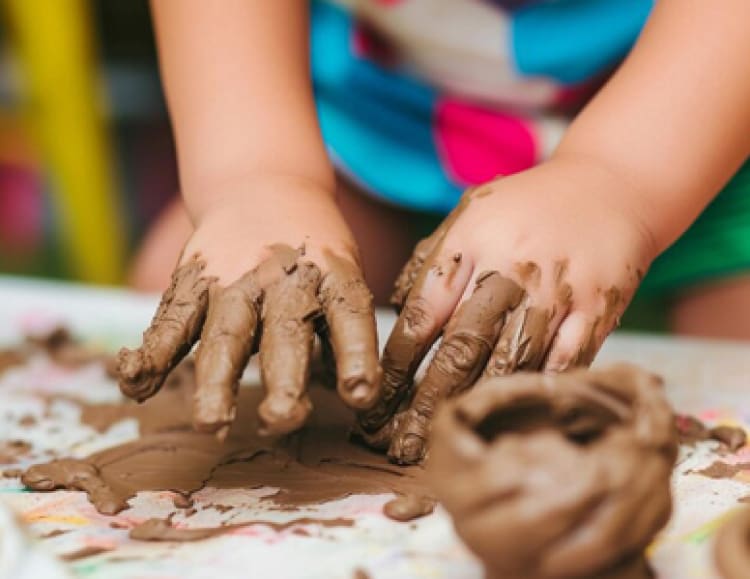
The same idea, offered three ways — as a picture, as a conversation, as something to physically do. Children pick the door that opens for them, and teachers note which one it was. That note follows them into Grade 1.
All eight intelligences are developed: linguistic, logical-mathematical, spatial, bodily-kinesthetic, musical, interpersonal, intrapersonal and naturalistic.
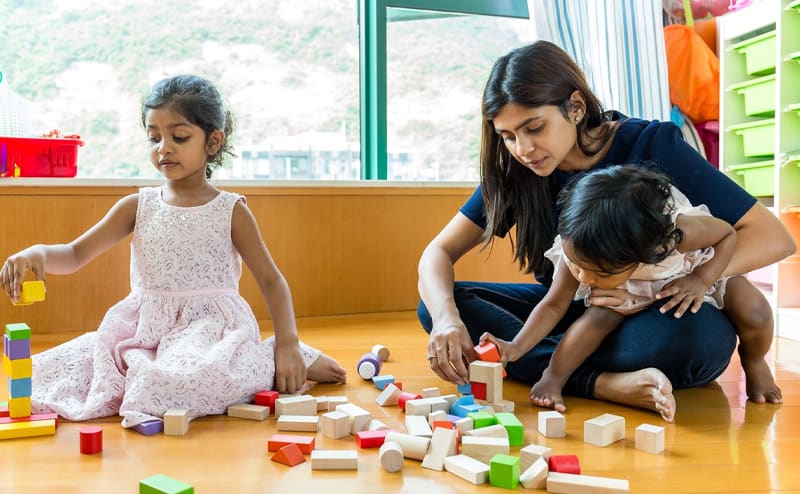
A room built around the idea that small children think with their hands. Counting is done with objects, not symbols. Volume is discovered by pouring. Most schools have labs; a room designed for concrete, hands-on early learning is rarer.
Alongside it sits the Contemplative Learning Centre — a quiet space for reflection and stillness. Both are the pedagogy rendered in architecture.

The pedagogy does not live in a document. It lives in whether the adult in the room says yes when a child proposes something, notices the quiet one, and resists the urge to hurry.
Our teachers are trained in Finnish teaching practices and our professional development runs continuously on that footing — learning-style recognition, differentiated instruction, mindfulness, and assessment for learning rather than assessment of children.
Talk to Nordi, our admissions assistant. Ask about the day, the ratio, the food, the transport route past your street — or say hei and see what happens. No form to fill in first.
Indicative — the rhythm is real, the clock is flexible by design.
Children arrive into an open room and choose where to begin. Nobody is rushed into a chair.
Songs, the weather, the calendar, news from home. Language, listening and belonging, all at once.
The week's phenomenon — water, seeds, shadows, our street — investigated with real materials.
Eating is taught, not just provided. Serving, sharing, clearing, trying one new thing.
Climbing, balancing, sand, water, running. The part of the day children describe first at home.
Mindfulness or rest, then art, music, movement or story — the expressive half of the day.
"What did you make today?" Metacognition, begun at four, in a form a four-year-old can hold.
"Be present. Listen to students. We need to give time to learn — there's no hurry."
— A Finnish educator, from the school's own content archive
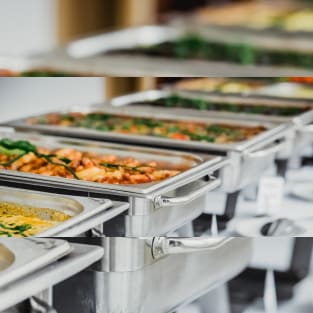
Finland's system treats proper nutrition and rest as part of the school day, not as something that happens around it. So we did not improvise it. Our meals are run in partnership with Sodexo, whose menus here are designed by qualified dieticians and cooked to an audited hygiene standard.
Meal service is optional for Pre-Primary. We will walk you through the menu on your visit.
 Est. 1990 · JAIN Group of Institutions
The hardest question a parent asks about a pre-school is the one they rarely say aloud: will this place still be here, and still be good, in ten years?
Jain Heritage School is part of the JAIN Group of Institutions, founded on Jain College in 1990 by Dr. Chenraj Roychand — who began as a salesman earning ₹50 a month. The group's stated mission is education "from cradle to career," and it means it literally: a child starting Playgroup here enters a pathway that runs all the way to JAIN (Deemed-to-be University).
Knowledge makes character. The group's founding principle, and still the point.
be bold, innovate, collaborate, empower, and have fun!
The values that drive everything we doIt has already started. Play is how children under six build language, number sense, self-regulation and social skill — and those are the foundations that make Grade 1 academics possible. Finnish teachers are clear that this works precisely because it sits on a well-structured curriculum, not instead of one. Literacy and numeracy are developed deliberately here; they are simply developed through activity rather than through worksheets.
No. Our pre-primary programme is designed as the on-ramp to our own Grades 1–5, and the handover is deliberate: your child's learning-style profile and portfolio move with them. The school follows the CBSE framework and the NEP 2020 5+3+3+4 structure throughout, so nothing about the early years sits outside the board pathway.
Fair question, and the honest answer is that you should not take our word for it. Come and look. What you should be able to see on a campus visit: teachers trained in Finnish teaching practices, children mid-activity rather than seated in rows, the Manipulative and Contemplative Learning Centres in use, daily mindfulness, and assessment recorded as observation and portfolio rather than as a rank. If you cannot see those things, the label means nothing — at any school.
Personalised attention is structurally impossible at high ratios, so this is a fair thing to press us on. We will give you the current figure for the specific class your child would join, on your visit — it is more useful than an average.
They are the reason the approach exists. Because we identify how a child learns rather than how fast, a child who needs more time gets targeted support instead of a lower place in a queue. Finland has among the lowest achievement gaps in the world, and that is not an accident of talent — it is a consequence of method.
Yes to both — school transport with pick-up and drop, and extended day care for families who need a longer day. Routes and timings are best checked against your actual address; ask Nordi, or raise it on the call.
We share the full structure — tuition, meals, supplies, transport by distance, and the discounts and concessions available — during your campus visit, so you get the complete picture rather than a headline number. Please disregard fee figures listed on third-party school-aggregator websites; several are years out of date.
Not an open day. An ordinary morning, with the children doing what they ordinarily do. It is the only school visit worth taking — and the only proof that actually settles the question.
Survey No. 190, Kannamangala Village, Bidarahalli Hobli,
Whitefield, Bengaluru 560067