
Finnish thinking · CBSE outcomes

Oppiminen Learning
that survives
the exam hall.

Grades 6 to 11 at Jain Heritage School, Whitefield. Full CBSE, taught so that a student can handle a question they have never seen before — which, since the board moved to competency-based assessment, is now exactly what the board asks.

Grades 6 · 7 · 8 · 9 · 10 Ages 12–16 Competency-based CBSE Optional enrichment from Grade 6

CBSE stopped rewarding recall. Most schools have not noticed yet.

The Grades 6–11 design

Two very different
halves of adolescence.
Taught differently.

Pedagogy here is not uniform across five years — a twelve-year-old and a sixteen-year-old are not the same learner, and pretending otherwise is how schools lose both of them. The stage is deliberately split.

Grades 6–8 · Ages 12–14

Transition to rigour

The years where a student either takes ownership of their own work or learns to wait to be told. We spend them building the first — through work that is genuinely theirs, and has to be defended out loud.

  • Project-based and self-directed learning
  • Presentations and communication skills — regularly, to real audiences
  • Co-curriculars given equal emphasis, not treated as extras
  • Multidisciplinary modules where the subject boundaries come down
  • Optional academic enrichment becomes available
Grades 9–10 · Ages 15–16

Academic intensity, without the panic

The board is now real and close. Intensity rises — but it rises on top of four years of understanding, rather than being applied as an emergency measure in Grade 9.

  • Preparation for competency-based CBSE examinations
  • Complex, multi-step problem-solving
  • Mental-ability and analytical reasoning development
  • Structured revision built on concepts, not on memorised answers
  • Socio-emotional support through the highest-pressure years

"Not everything from Finland applies here. We adopt the best practices that work for our students and fit within the CBSE framework."

— Jain Heritage School, Whitefield · Institutional Framework
The rigour answer

You are not choosing
between understanding
and marks.

This is the objection every parent of a Grade 8 student arrives with, and it deserves a real answer rather than reassurance. Here it is.

CBSE is itself shifting from rote to competency-based assessment under NEP 2020. Finnish pedagogy's entire emphasis is understanding, application and critical thinking. Those are the same thing, arrived at from two directions.

We are not deviating from the board. We are ahead of where the board is already going.

So the real question is not whether this method is risky. It is whether a school still teaching to memorisation is ready for how CBSE is actually examining now.

Full CBSE curriculum framework

Every subject taught to CBSE specification. Nothing dropped, nothing substituted.

5+3+3+4, aligned to NEP 2020

The national structure, implemented properly through the Middle and Secondary stages.

Competency-based assessment

The board's own current framework — and the one this pedagogy was built for.

Evaluation standards maintained

Rigorous grading and structured board-examination preparation.

Competitive-exam pathway intact

Students who choose JEE or NEET are supported on that path, not steered off it.

Full compliance reporting

All CBSE-mandated reporting, maintained as a matter of course.

★ Optional · opt-in from Grade 6

Want more depth?
Take more depth.

Some families want additional academic push. Some emphatically do not. Both are reasonable, and a school that forces one answer on every child is making a decision that belongs to the parent.

So our Foundation Program sits alongside the curriculum rather than inside it. It is an optional academic enrichment programme, available from Grade 6, for students who want to go further and faster. Choosing it changes nothing about the school day for everyone else.

"Will my child be competitive?" — Yes. And you decide how much.

We don't force intensity on children who don't need it, and we don't withhold it from families who want it.

A student speaking to the room while classmates listen
Project-based learning

Work with your name
on it, defended out loud.

Between Grades 6 and 8, a growing share of learning is project-based and self-directed. Students choose an angle, plan the work, hit the problems that plans always hit, and then stand up and explain what they found.

The presentation is not decoration. Being able to explain your reasoning to a sceptical room is the single most transferable skill in this building — and it happens to be what competency-based examinations are trying to measure on paper.

Students and a teacher testing a wind-turbine model together
Phenomenon-based modules

Real problems don't
arrive labelled by subject.

Every student takes part in at least one multidisciplinary module a year — a real phenomenon investigated across whatever subjects it genuinely requires, sometimes with several teachers at once.

Purpose is supplied deliberately: the UN Sustainable Development Goals are used as learning themes that bind competences and subject content together. When a fourteen-year-old realises they can point what they are learning at something they actually care about, the motivation problem largely solves itself.
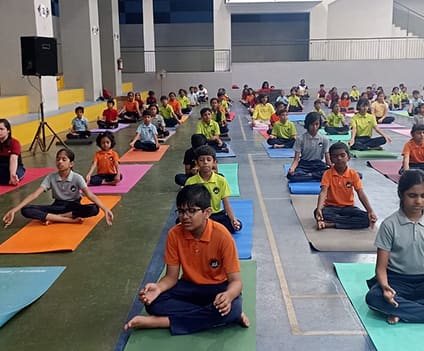
Students on mats during a whole-school mindfulness session
Well-being is not a wellness add-on

The years that break
students are the years
we watch hardest.

Grades 9 and 10 are where academic pressure and adolescence collide. We treat socio-emotional well-being as a precondition for academic performance rather than as a reward for it: daily mindfulness, explicit stress-management and emotional regulation, and deliberate resilience building.

The Contemplative Learning Centre is a physical room for this, which sounds like a small thing until you have watched a sixteen-year-old need somewhere to go.

A teacher working through a build at the bench with a group of students
The people who do it

Facilitators and designers
of learning — not
content deliverers.

That is the school's own stated principle, and it is the whole mechanism. Our teachers are trained in Finnish teaching practices, with continuous professional development in inquiry-driven teaching, differentiated instruction, assessment for learning, and socio-emotional support.

"You should always listen to students and their ideas — and if there's no reason to say no, you should rather say yes. It gives students the sense of capability and the feeling that they are an active part of the school community."
— A Finnish educator, from the school's content archive


Got a specific question about Grades 6–11?

Ask Nordi, our admissions assistant — subject options, the enrichment programme, board preparation, transfer certificates, the bus route past your street. Or say hei and see where it goes. No form first.

Let's talk about what this costs

We are not the cheapest
CBSE school in Whitefield.
We are not trying to be.

You will find CBSE schools in this corridor for meaningfully less. If the board certificate is the only thing that matters to you, one of them is the right answer, and we would rather say so than waste your Saturday.

The comparison we think is honest is the other one. Against international schools in Whitefield — where fees commonly run to several times a mainstream CBSE bill — we deliver international-standard pedagogy on a CBSE pathway: more portable within India, better aligned to JEE and NEET, and considerably less expensive.

International-standard pedagogy, with the board Indian parents actually want.

Mainstream CBSE
Board certificate
Jain Heritage School
Board certificate + international pedagogy
IB / IGCSE schools
International pedagogy + international board

Indicative positioning, not a price comparison. We will share the full fee structure — including sibling, full-payment and merit concessions — on your campus visit. Please disregard fee figures on third-party school-aggregator websites; several are significantly out of date.

Est. 1990 · JAIN Group of Institutions
After Grade 10

The question behind
every school choice:
and then what?

Jain Heritage School is part of the JAIN Group of Institutions, founded on Jain College in 1990 by Dr. Chenraj Roychand — who began as a salesman earning ₹50 a month. The group's stated mission is education "from cradle to career," and the pathway is real rather than rhetorical.

There is also a genuine philosophical fit here, and it is worth stating plainly rather than implying. JGI was founded on education and entrepreneurship — it coined the word "Edupreneurship" and runs a business incubator. The Finnish National Core Curriculum is the only national curriculum in the world with working life skills and entrepreneurship written in as a core cross-curricular competence.

A group built on entrepreneurship adopting the one curriculum that treats entrepreneurship as foundational is a coherent strategic choice, not a trend purchase.

Pre-Primary Grades 1–5 Grades 6–11 Jain Colleges JAIN (Deemed-to-be University) · NAAC A++

"Cradle to career" is the group's own phrase. A student finishing Grade 10 here is already inside the pathway, not applying to it.

Knowledge makes character.  The founding principle, and still the point.

Well-being is always first

A fifteen-year-old
running on a packet of
biscuits cannot think.

Finland's system treats proper nutrition, exercise and rest as structural parts of the school day rather than as things that happen around it — and in the years when students are growing fastest and studying hardest, that is not a soft point. Our meals are run in partnership with Sodexo, with menus designed by qualified dieticians and cooked to an audited hygiene standard.

  • 1Hot, freshly cooked meals on campus, every school day.
  • 2Portions and nutrition built for adolescent growth and energy demands.
  • 3Allergy and dietary requirements recorded at admission and honoured daily.
  • 4No canteen queues eating into a short break, and no skipped lunches.

Meal service is part of the programme for Grades 1–10. See the full menu on your visit, or read the meal plan.

Hot meal counters laid out in the school dining hall
The bottom line

We believe children learn best when they are…

Straight answers

What parents actually ask us.

Will my child be ready for JEE, NEET or other competitive exams?

Yes. Students develop the critical thinking and problem-solving that those papers are built to test — we are not skipping rigour, we are delivering it differently. The CBSE pathway stays completely intact. Families who want additional depth can opt into the Foundation Program from Grade 6, which brings specialist faculty, dedicated content and Olympiad exposure.

Is the Foundation Program compulsory? Is it a coaching class?

It is opt-in, and no student is enrolled by default. It is an academic enrichment programme rather than a coaching factory — the emphasis is on mental flexibility, analytical reasoning and conceptual depth rather than sheer volume of practice problems. A student who does not take it loses nothing from the core curriculum.

Are you removing board exam preparation?

No. We prepare students for CBSE examinations using methods that develop deeper understanding — which is better preparation than rote memorisation, not weaker. Evaluation standards, grading rigour and all CBSE-mandated reporting are maintained in full.

My child is joining in Grade 8 or 9 from another school. Is that wise?

It is common, and the syllabus is not the issue — CBSE is CBSE, so there is no content gap to close. What takes adjustment is the expectation of independence: students arriving from a heavily directed classroom often need a term to get comfortable being asked what they think rather than told what to write. We map learning style on arrival and support that transition deliberately. For Grade 10 specifically, talk to us about timing — mid-board-year transfers deserve a real conversation rather than a web page.

What about a student who is struggling academically?

Our approach helps a struggling student more, not less, because the first move is to identify how they learn and provide targeted support — rather than repeating the same delivery at higher volume. Finland has among the lowest achievement gaps in the world, and that is a consequence of this design rather than of talent.

How is progress reported to parents?

Through required CBSE assessment and reporting, plus continuous formative evidence — teacher observation, portfolio documentation, project and presentation work, and self-assessment. The intent is that you can see how your child is developing, not just where they placed.

Do co-curriculars get squeezed out in Grades 9 and 10?

They are explicitly not treated as extras — sports and physical education, arts, technology and innovation, community service and leadership development carry real weight from Grade 6 onward. In the board years the load is managed rather than cancelled, because a student who drops everything but revision for two years usually revises worse.

What are the fees?

We share the full structure — tuition, meals, supplies, transport by distance, and the discounts and concessions available, including sibling and full-payment concessions — on your campus visit. Please disregard fee figures on third-party school-aggregator websites; several are significantly out of date.

Admissions open · Grades 6–11

Ask us the hard
questions in person.

Board results, class size, what happens to a struggling student, whether the enrichment programme is worth it for your child. Come and put them to a counsellor and to a teacher, on campus, with the school running normally around you.

Survey No. 190, Kannamangala Village, Bidarahalli Hobli,
Whitefield, Bengaluru 560067

📞 +91 89513 61982